The stimulus
A photo or short clip
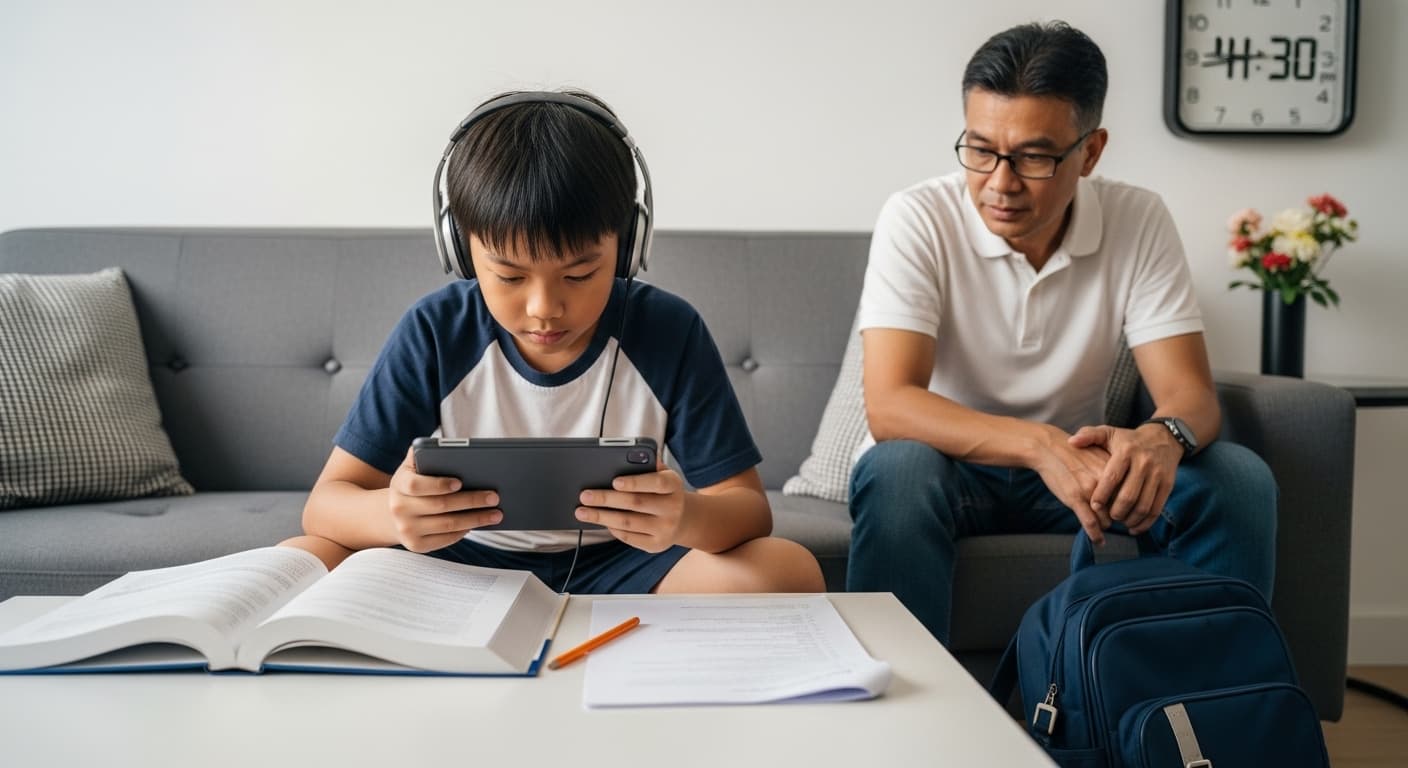
English Oral uses a real-life photograph. Chinese Oral uses a 短片 for 看录像会话.
PSLE Stimulus-Based Conversation · Updated 10 June 2026
Conversation carries the most marks in both exams — 25 of 40 in English, 30 of 50 in Chinese. And it is the component where consistent practice makes the biggest difference. SBC is not a script to memorise. It is a speaking skill: respond to a photo or short clip, explain what you notice, connect it to real experience, and give a reasoned view. English Oral uses a photograph. Chinese Oral uses a 短片 for 看录像会话.
English Oral
Photo-based conversation
Chinese Oral
看录像会话 · 短片
Quick answer
It is the conversation part of oral practice where the child must respond to a visual stimulus and then extend their answer. The mark is not just in spotting details. It is in speaking clearly, explaining ideas, using examples, and handling follow-up questions.
The stimulus
English Oral uses a real-life photograph. Chinese Oral uses a 短片 for 看录像会话.
The answer
Strong answers refer to the stimulus, then add a reason and a personal or real-world example.
The trap
The examiner can ask follow-ups. Children need flexible answer moves, not pre-written paragraphs.
Why it matters
Reading Aloud is over in two minutes. The conversation continues for several more — and it is worth more marks in both English and Chinese Oral.
English Oral · Paper 4
Stimulus-Based Conversation — 25 marks. Reading Aloud — 15 marks. Oral contributes 20% of the English Language grade.
Chinese Oral · 华文口试
看录像会话 — 30 marks. 朗读篇章 — 20 marks. Oral contributes 25% of the Chinese Language grade.
Conversation is where most of the grade gap opens and closes.
Reading Aloud performance is relatively stable — children read at roughly the same level each time. Conversation varies much more: a child who extends answers, uses specific examples, and handles follow-up questions consistently outscores one who runs out of things to say after 30 seconds. That gap is trainable, and it is what PSLEPrep practice targets.
English vs Chinese
Treat the formats separately when practising, but train the same core skill: turn what the child sees into a clear spoken answer.
PSLE English Oral
The child studies a real-life photograph, describes what is happening, infers feelings or purpose, then answers broader experience or opinion questions.
PSLE Chinese Oral
The child watches a 短片, then answers 华文口试 questions about what happened, what they think, and how the theme connects to daily life.
Question types
The exact wording changes, but strong answers usually combine these moves. This is what makes the child less dependent on scripts.
Observe
Name concrete details from the photo or short clip before jumping to opinions.
Infer
Explain feelings, purpose, relationships, and likely next actions using evidence from the stimulus.
Connect
Give a real example with who, where, what happened, and what the child learnt.
Extend
Answer with a clear point, reason, example, and a link back to the question.
How to answer
The goal is not to memorise a polished paragraph. The goal is to give your child a repeatable way to notice details, organise thoughts, and extend answers when the examiner asks a follow-up.
Before answering, look for who, what, where, when, why, and how. This prevents the one-detail answer that ends after a single sentence.
Point, Explain, Example, Link gives the answer a clear shape. It works for opinions, suggestions, and many follow-up questions.
A small real story from school, home, CCA, or the neighbourhood usually scores better than a broad statement about what people should do.
Strong answers do not ignore the photo or short clip. Mention one visible detail before moving into the broader idea.
A short pause is better than a rushed answer. The child can ask for the question to be repeated or start with a simple framing phrase.
For experience questions, explain how the child felt and what changed afterwards. That turns a plain event into reflection.
End with a short link back to the question. This tells the examiner the answer is complete and stops the child from trailing off.
Weak answer
"Yes, I think children should help at home because it is good."
This answers the question, but it gives no concrete example and no link back to the situation.
Stronger answer
"Yes. In the picture, the child is helping an adult carry groceries, so I think the activity shows responsibility. At home, I help my mother set the table before dinner. It is a small job, but it saves her time and reminds me that family members should support one another."
This is stronger because it uses a stimulus detail, a clear reason, a personal example, and a final link.
Exam-day checklist
Use this as a final check during practice. If an answer has at least four of these six moves, it usually sounds much more complete.
Name one visible detail from the photo or short clip before giving an opinion.
Answer the question directly in the first sentence.
Give one reason, not a list of unrelated points.
Add one specific example or personal experience.
Link the answer back to the question before stopping.
If stuck, pause, breathe, and ask for the question again instead of guessing wildly.
Practice paths
The fastest improvement comes when the child answers aloud, hears the answer back, and fixes one weakness at a time.
English full path
Reading Aloud plus photo-based conversation in one practice path.
English SBC drill
5W1H photo warm-up plus Q1-Q3 examiner-style prompts.
Chinese conversation
Short-clip conversation with 华文口试 questions and parent-readable feedback.
Question bank
Reported English and Chinese Oral themes for pattern practice.
Exam rehearsal
Timed preparation, spoken answers, and a parent-readable report.
FAQ
Stimulus-Based Conversation is the spoken conversation after a visual stimulus. In English Oral, the current stimulus is a real-life photograph. In Chinese Oral, the conversation is based on a short clip, described on PSLEPrep as 看录像会话.
Parents often use SBC when talking about English Oral, but the same broad idea applies across oral exams: the child responds to a stimulus, then extends their answer with reasons, examples, experience, and opinions. Use the correct subject terms when practising: English photo conversation, and Chinese 看录像会话 based on a 短片.
No. Memorised answers usually break when the examiner asks a follow-up question. Practise reusable answer moves instead: observe, infer, connect to experience, give a view, and explain with examples.
Use one picture or short clip at a time. Ask the child to describe what they notice, infer what is happening, connect it to a real experience, and give an opinion with a reason and example. Recording the answer helps because many children only hear the gaps when they play it back.